
The Dept. of Species Services (DSS)
Exploring how human labor might be reassigned by artificial intelligence to sustain ecological systems through a commons-based model of care.
The Department of Species Services (DSS) explores a near-future in which artificial intelligence no longer serves solely as a tool for human productivity, but operates as an institutional system that reorganizes labor across species and environments. By reframing work as ecological participation rather than economic output, DSS responds to growing anxieties around automation by proposing an alternative: a world in which humans are reassigned roles within planetary systems. Through interactive assessments, job assignments, and embodied performances, the project transforms speculative futures into lived experiences, operating at the boundary between fiction and institutional plausibility.
Related Future Simulations:
AI Simulation - DSS Job Platform
Performance - Until the Bees Return
Interactive Installation - Pollination Unit
Gray Area Art & Technology
University of California, Davis
University of California San Diego
2025- Now (On-going)
Details
Details
Details
Details
Details
Concept Video:
Artificial intelligence is still widely understood as a tool, optimized for efficiency, scale, and economic productivity. Yet as these systems expand, they are already reshaping the conditions of work itself. Automation promises convenience while producing a growing sense of instability: what roles remain for humans, and who, or what, defines their value? At the same time, the infrastructures that sustain AI carry significant ecological cost, consuming energy at scales that mirror the crises they are often tasked to address.
The Department of Species Services (DSS) proposes an alternative trajectory. Set in a near future, DSS is an AI-managed ecological commons trust, an institutional system that coordinates human participation across multi-species environments. Operating under a Neo-Gaian framework, DSS treats the biosphere as a shared, interdependent network in which humans, animals, plants, and microbial life are co-participants.
Here, AI no longer functions solely as a tool, but as a governance layer, monitoring ecological conditions, identifying imbalances, and allocating human intervention where it produces the least disruption and the greatest systemic benefit. Rather than optimizing for human productivity, DSS redefines labor as ecological function. Work is no longer organized around markets or nations, but around sustaining the continuity of living systems. Within this model, human anxiety around obsolescence is not resolved, but redirected. Humans are not replaced, they are reassigned. Roles emerge where ecological gaps appear, positioning human presence as a form of support within planetary processes.
DSS AI Job Platform Simulations
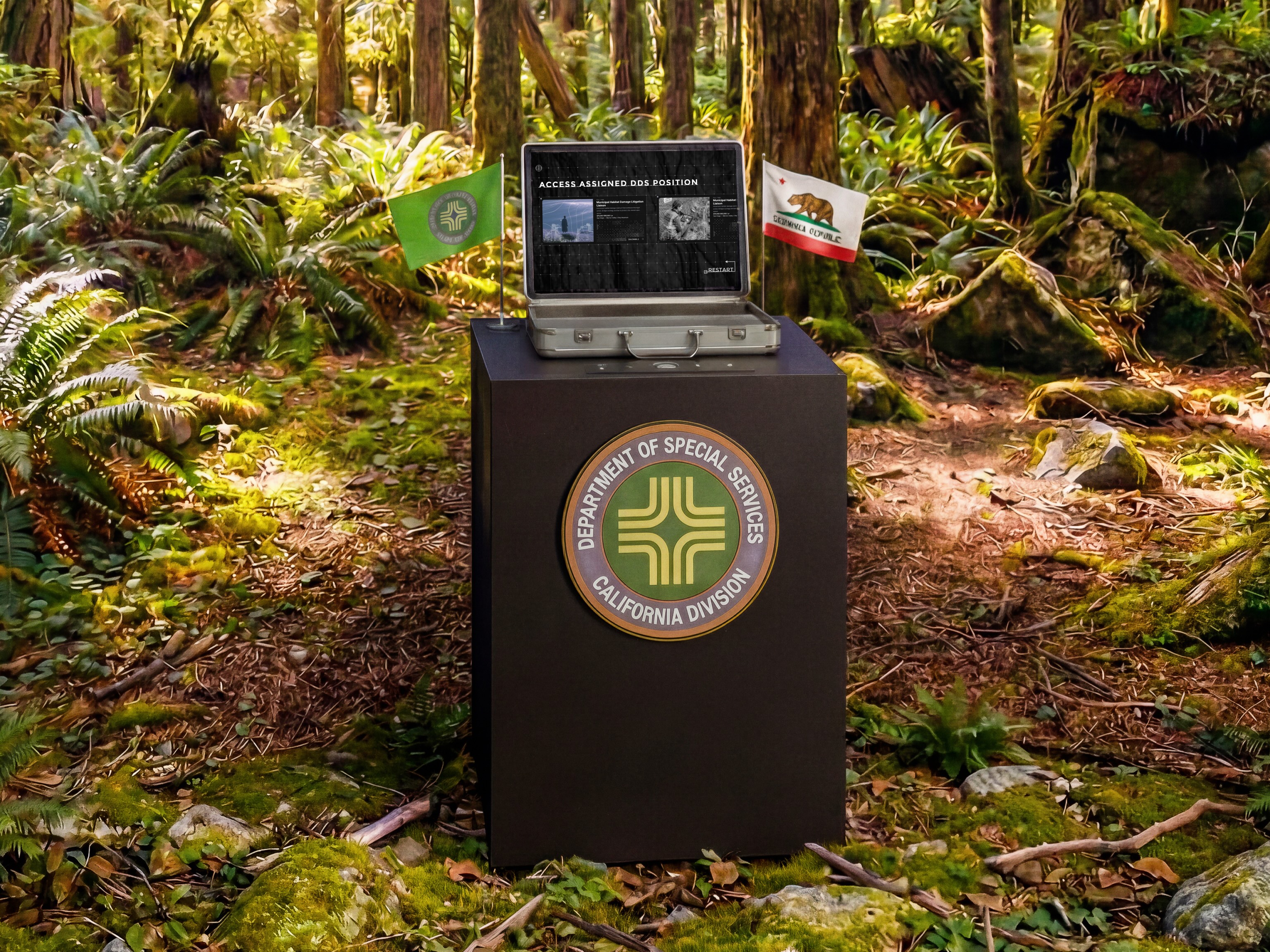
DSS AI Job Platform Simulations uses a custom AI model to analyze real-world environmental challenges, from polluted rivers and disrupted bird migrations to urban flooding, and propose ecologically centered interventions. It translates these interventions into speculative human job roles, imagining how labor might be reorganized around ecological care, adaptation, and accountability. Through an interactive platform interface, audiences can explore these roles and be matched with an ecological job suited to their skills and preferences.
DSS Unit 01: Pollination Unit
Pollination Unit is the first project in the DSS series. Set within California ecosystems, it examines the risks that declining yellow-faced bumblebee populations pose to the pollination of native wildflowers, including the California poppy, and to the wider ecological relationships sustained by this seasonal labor.
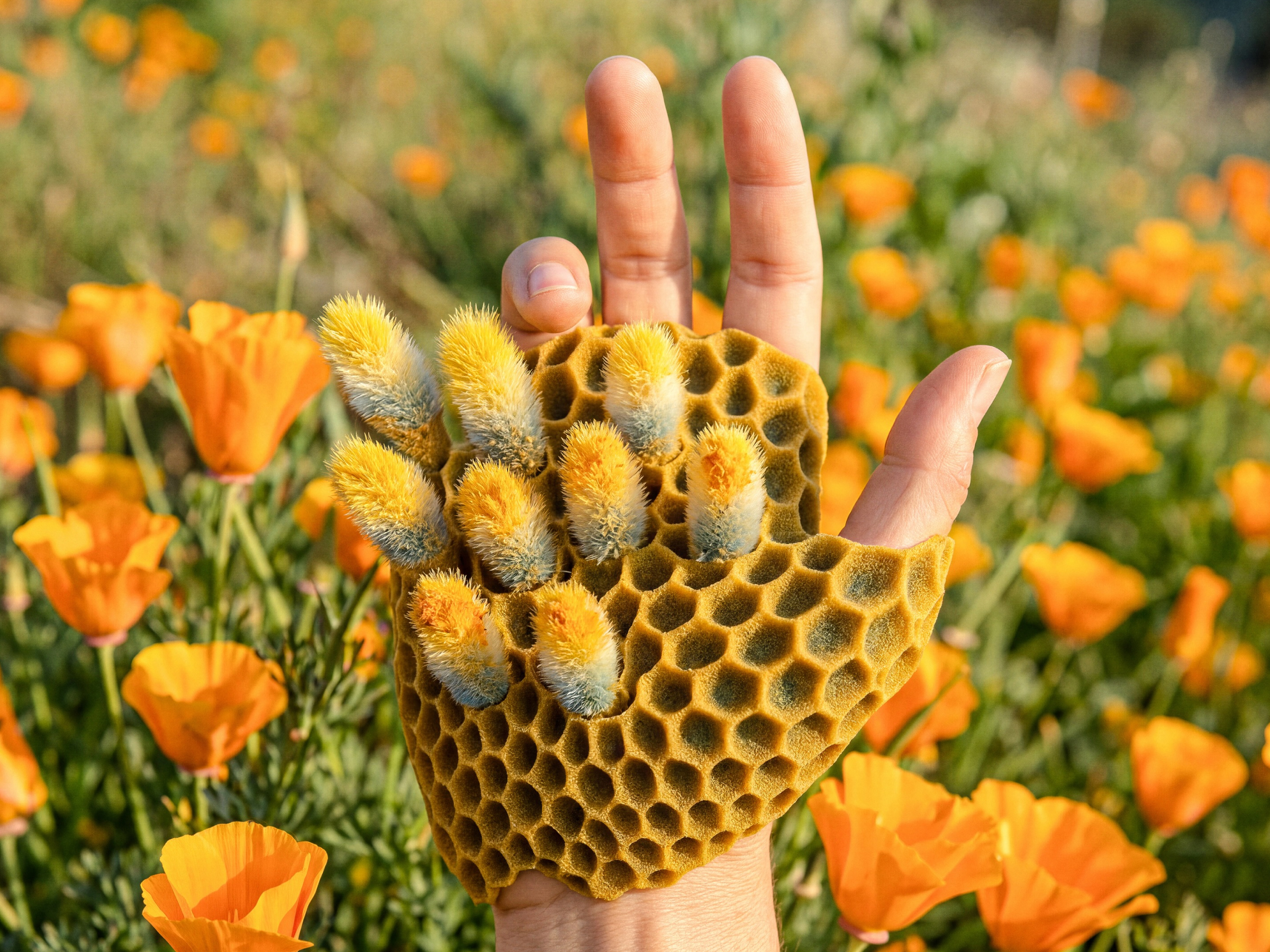
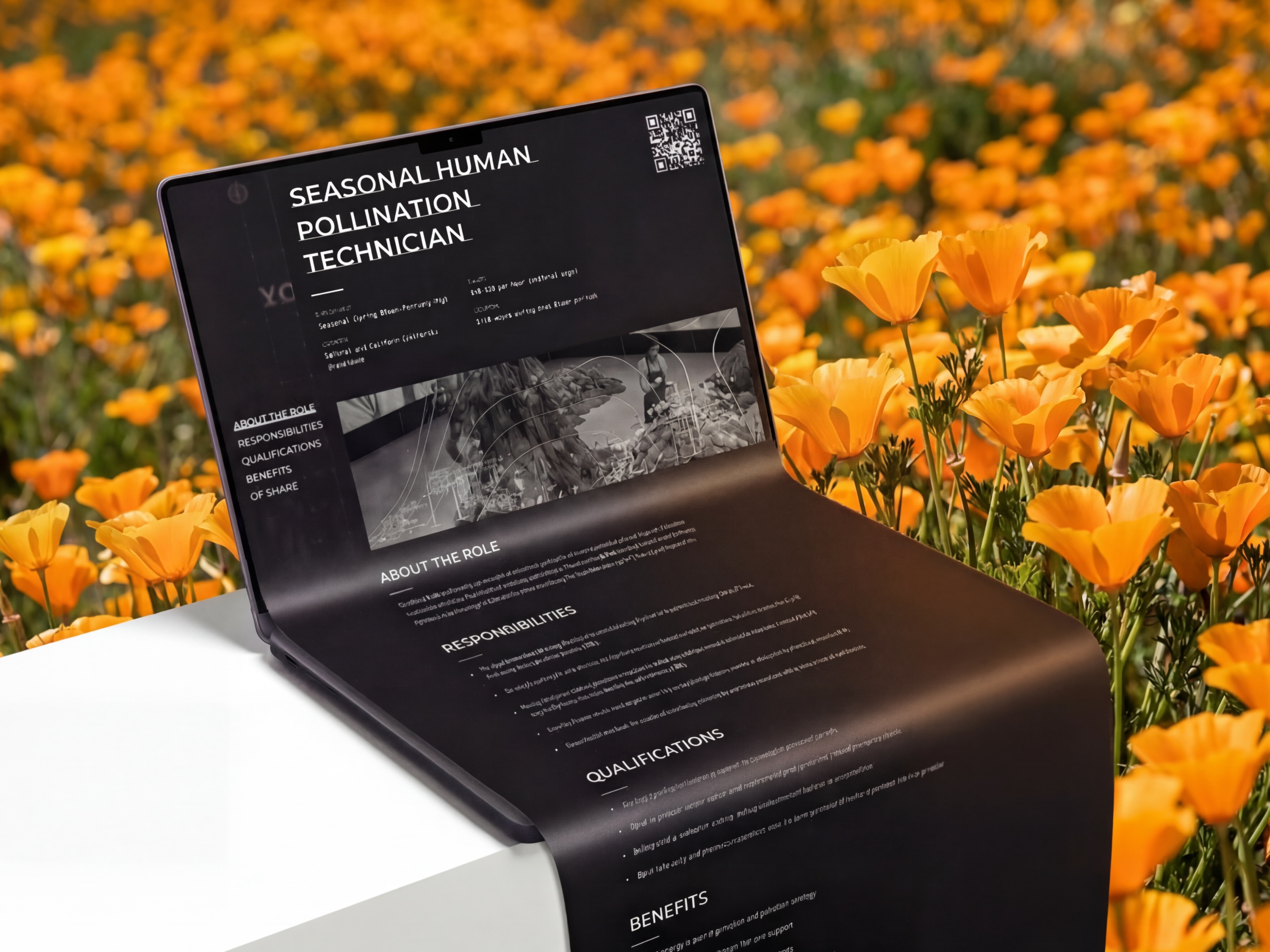
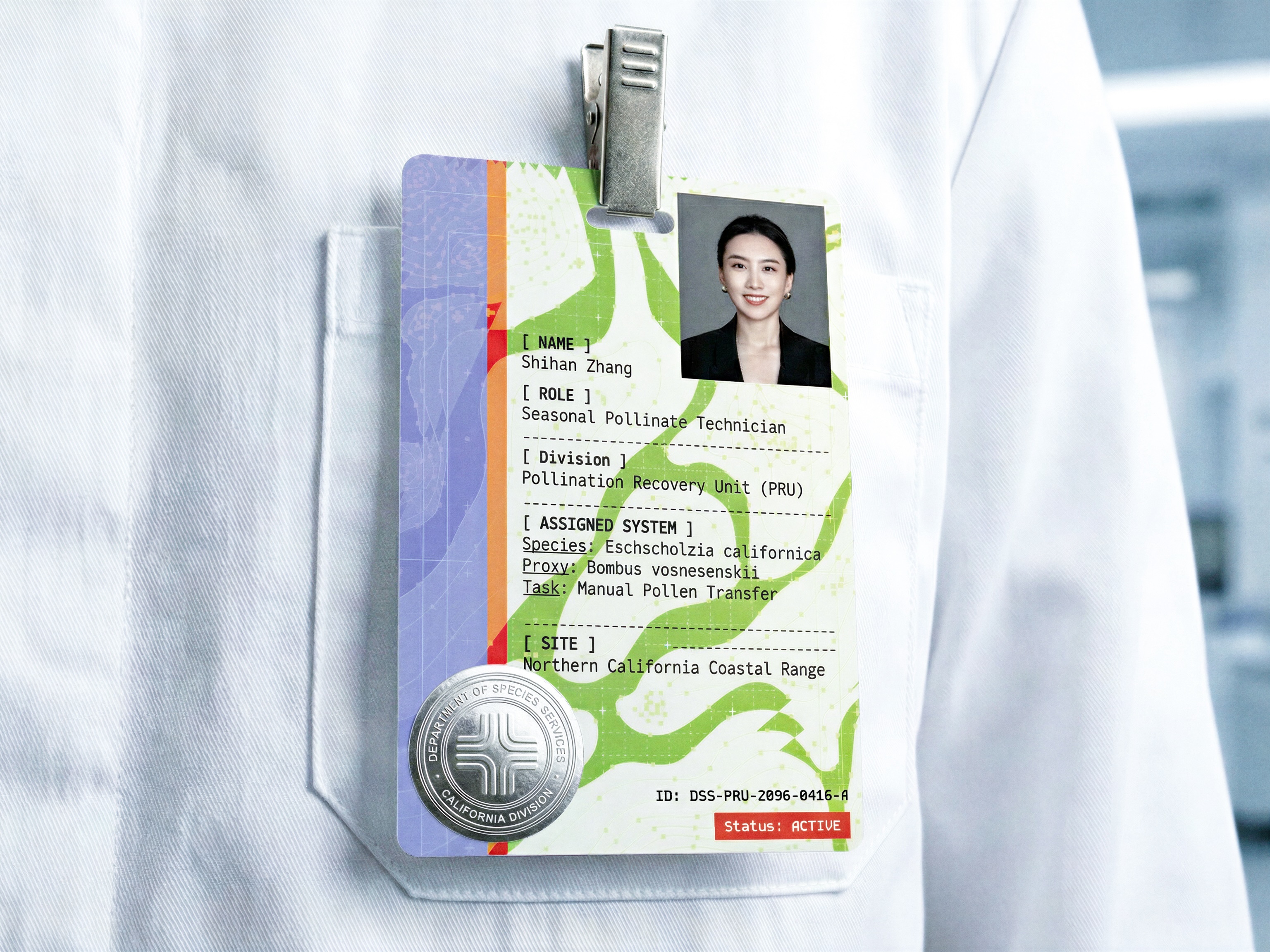
In response to a speculative pollinator collapse, DSS creates a new emergency job: the Human Pollinator. Recruited workers temporarily assume part of the bee’s ecological function, moving through wildflower fields to collect and transfer pollen by hand. The role reframes humans not as distant stewards of nature, but as temporary workers embedded within an interdependent ecological system. Workers are equipped with the DSS Pollination Glove, a wearable tool that extends the hand into a pollination device and transforms touch into a precise, repetitive form of ecological labor. The project is materialized through interactive installations with live AI simulations and live performance.
Operating at the threshold between fiction and institutional plausibility, DSS transforms speculative futures into operational systems. It does not resolve the contradictions of AI, but reorganizes them, proposing a world in which intelligence, both artificial and biological, is redirected toward sustaining the conditions of life. Ultimately, The Department of Species Services invites a rethinking of labor, value, and responsibility in the age of AI, asking not what AI can do for humans, but what humans are still needed for within a shared planetary system.
.jpeg)
The glove’s base design uses a beehive-inspired structure to improve stability.
.jpeg)

Credits
Director & Futurist: Shihan Zhang
The Pollination Unit:
Creative Technologist: Mingyong Cheng
Interactive Engineer: Han Zhang
Sound Design / Computer Musician: Han Zhang
Concept Video Storyboard: Shihan Zhang
P-Glove Design: Ziwei Liu, Shihan Zhang
Installation Design: Shihan Zhang
Visual Identity & Graphic Design: Ziwei Liu, Shihan Zhang
Fabrication: Shihan Zhang, Ziwei Liu
DSS Job Allocation Platform:
Concept Design: Shihan Zhang
AI Systems & Data Infrastructure: Jiaye Leng
UX & Front End: Ziwei Liu
Produced by
alter+
Gray Area Art & Technology
/local memory
Special Thanks
Curators: Wade Wallerstei, Jeff Hawkins, Chris Giang, Irish Tee-Sy
Production & Operational Staff: Andre Duque, Steve Piasecki
Videophotographer: Ziteng Wang
Photographers: Ziwei Liu, Kristin Lin, Rainy
ADVISOR:
Neal Williams — Consulting Pollination Ecologist, University of California, Davis